| Merci beaucoup (original) | Merci beaucoup (translation) |
|---|---|
| Pour Monsieur le savant, savant, | For Mister scholar, scholar, |
| Qui a le prix Nobel, | Who has the Nobel Prize, |
| Pour les autres qui dans cent ans | For the others who in a hundred years |
| Nous rendront éternels, | Will make us eternal, |
| Pour l’avion qui dans le brouillard | For the plane that in the fog |
| Retrouve son terrain, | find his ground, |
| Pour la joie de dire le soir | For the joy of saying the evening |
| «À demain!»: | "Until tomorrow!": |
| Merci bien, | Thanks very much, |
| Merci bien, | Thanks very much, |
| Merci beaucoup, | Thanks very much, |
| Merci beaucoup, | Thanks very much, |
| Oh oui. | Oh yes. |
| Pour ceux qui très tôt le matin | For those who very early in the morning |
| S’en vont de leur banlieue, | Go away from their suburbs, |
| Et pour toi qui plantes un sapin | And for you who plant a fir tree |
| Bien que tu sois très vieux, | Although you are very old, |
| Pour le noir qui chante à Saint-Louis, | For the black who sings in Saint-Louis, |
| Pour le rouge à Moscou, | For the red in Moscow, |
| Pour le riz du petit Hindou | For the little Hindu's rice |
| Qui a faim: | Who is hungry: |
| «Merci bien, | "Thanks very much, |
| Merci bien, | Thanks very much, |
| Merci bien, | Thanks very much, |
| Merci bien, | Thanks very much, |
| Merci beaucoup, | Thanks very much, |
| Merci beaucoup, | Thanks very much, |
| Oh oui.» | Oh yes." |
| Pour Chaplin et pour Picasso, | For Chaplin and for Picasso, |
| Pour Molière et Shakespeare, | For Molière and Shakespeare, |
| Pour les intelligents, les sots, | For the clever, the foolish, |
| Les meilleurs et les pires, | The best and the worst, |
| Pour le diable et pour le bon Dieu | For the devil and for the good Lord |
| Qui s’entendent si bien, | Who get along so well, |
| Pour tes dents et pour tes cheveux, | For your teeth and for your hair, |
| Et pour rien: | And for nothing: |
| «Merci bien, | "Thanks very much, |
| Merci bien, | Thanks very much, |
| Merci bien, | Thanks very much, |
| Merci bien, | Thanks very much, |
| Merci beaucoup, | Thanks very much, |
| Merci beaucoup, | Thanks very much, |
| Oh oui.» | Oh yes." |
| Pour les secondes et pour les heures | For seconds and for hours |
| Que nous jette le temps, | What time throws at us, |
| Pour l’enfant qui rit ou qui pleure, | For the child who laughs or who cries, |
| Mais qui est bon enfant, | But who is good child, |
| Pour la fille qui va donner | For the girl who will give |
| Son premier cri d’amour, | Her first cry of love, |
| Pour le fils qui prend le chemin | For the son who takes the path |
| Qui retourne: | Which returns: |
| «Merci bien, | "Thanks very much, |
| Merci bien, | Thanks very much, |
| Merci bien, | Thanks very much, |
| Merci bien, | Thanks very much, |
| Merci beaucoup, | Thanks very much, |
| Merci beaucoup, | Thanks very much, |
| Merci beaucoup.» | Thanks very much." |
Translation of the song lyrics Merci beaucoup - Gilbert Bécaud
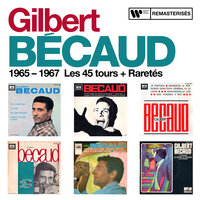
Song information On this page you can read the lyrics of the song Merci beaucoup , by -Gilbert Bécaud
In the genre:Эстрада
Release date:18.03.2021
Song language:French
Select which language to translate into:
Write what you think about the lyrics!
Other songs by the artist:
| Name | Year |
|---|---|
| 2006 | |
| 2015 | |
| 2014 | |
| 2012 | |
| 2014 | |
| 2006 | |
| 2017 | |
| 2014 | |
| 2014 | |
| 2015 | |
| 2014 | |
| 2014 | |
| 2014 | |
| 2015 | |
| 2019 | |
| 2014 | |
| 2019 | |
| 2014 | |
| 2012 | |
| 2014 |